You’re not losing people to competitors. You’re losing them to exhaustion.
The Cost You’re Not Tracking
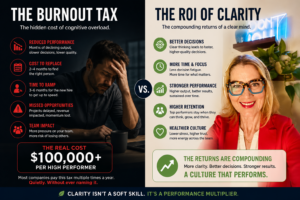
Most companies think turnover is a recruiting problem. It’s not. It’s a system failure under pressure. And it’s exacting a burnout tax.
High performers aren’t leaving because someone offered them slightly more money. They’re leaving because the cognitive load of their role became unsustainable. Because they were juggling too many decisions, ambiguity and no system to help them reset they had no other choice. Here’s the part leaders consistently underestimate:
Each departure isn’t just a replacement cost. It’s a six-figure tax on your business.
And that burnout tax? It’s quiet, consistent and compounds over time.
What “Exhaustion Turnover” Actually Looks Like
This isn’t dramatic burnout and it’s more subtle. Your best people:
- Start second-guessing decisions they used to make quickly
- Take longer to respond, not because they’re slow, but because they’re overloaded
- Default to safe choices instead of strategic ones
- Disengage before they exit
By the time they turn in their resignation letter, the signs were there for months. You were likely too cognitively overloaded yourself to see them.
You didn’t lose them in a moment. You lost them through accumulated decision fatigue.
The Real Drivers Behind the Exit
Let’s strip away the usual explanations. People say they’re leaving for:
- Better opportunity
- Compensation
- Growth
Sometimes that’s true. But underneath, the consistent pattern is this: They no longer trust their ability to operate clearly inside your environment.
Why? Because:
- Every decision feels urgent
- Priorities constantly shift
- Context is incomplete
- There’s no recovery time between high-stakes thinking
That creates a state of continuous cognitive strain and eventually, the brain opts out.
The Six-Figure Reality Per Departure
Most leaders underestimate the math behind each exit. The burnout tax is real and can be calculated when a high performer leaves:
1. Productivity loss (pre-exit): 3–6 months of degraded output before resignation
2. Vacancy gap: Time to backfill the role, often 60–120 days
3. Ramp time: Another 3–6 months before the replacement reaches full effectiveness
4. Decision quality impact: Missed opportunities, slower execution, poor calls made under pressure while you were focused on recruiting, hiring, onboarding a new employee
5. Cultural drag: Remaining team absorbs workload, increasing their own fatigue risk
You’re not replacing a person. You’re absorbing a performance gap across 6–12 months and that’s where the six figures come from.
A Simple ROI Lens: What This Is Actually Costing You
Let’s make this concrete. Use this as a baseline model for one high performer:
- Salary: $120,000
- Productivity loss as they start checking out (25% over 4 months): $10,000
- The vacancy while you recruit someone new (3 months): $30,000
- Ramp inefficiency to onboard a new employee (50% productivity over 4 months): $20,000
- Recruiting + onboarding costs: $15,000
- Decision impact + missed opportunities: conservatively $25,000
Total estimated cost: $100,000+ per departure
And that’s a conservative model. Now multiply that across multiple roles per year and you can see how the burnout tax affects the bottom line.
Where Decision Fatigue Fits In
Here’s the connection most organizations miss: Decision fatigue is a leading indicator of this turnover.
When your environment forces people to:
- Process too many unstructured decisions
- Operate without clarity on what matters
- Stay in constant reactive mode
You are draining the very resource they’re paid for: Their ability to think clearly under pressure.
Once that degrades, everything follows.
A Practical “Decision Fatigue → Turnover” Calculator
You don’t need a complex system to start measuring this. Track these three inputs across your team:
1. Decision Load (weekly): How many meaningful decisions is this role responsible for?
2. Clarity Rating (self-reported, 1–10): “How clear do you feel in your decision-making right now?”
3. Recovery Frequency: How often do they have structured time to reset thinking?
Now look for patterns:
- High load + low clarity + low recovery = risk zone
- Sustained for 4–6 weeks = probable disengagement
- Sustained for 8–12 weeks = turnover likelihood increases significantly
This is early warning data and most companies only measure the outcome. High-performing organizations measure the conditions that create the outcome.
The Strategic Shift
If you want to reduce turnover and minimize the burnout tax for your high-performers, stop focusing only on retention tactics. Focus on cognitive sustainability. That means:
- Reducing unnecessary decision load
- Clarifying what actually matters
- Building reset mechanisms into the workday
- Training people to separate facts, assumptions, and pressure in real time
This isn’t soft. It’s operational performance design.
What to Do Next
Start here:
- Identify your top 3 critical roles
- Assess their current decision load and clarity
- Look for signs of sustained pressure without recovery
- Introduce structured reset points into their day
- Measure clarity improvement over 2–3 weeks
You’re not trying to eliminate pressure. You’re making sure your people can operate effectively inside it.
Bottom Line
You don’t have a retention problem. You have a decision environment problem.
Fix the environment, and you don’t just retain talent. The result – restored performance.
Call to Action: Fix the System, Not Just the Symptom
If you’re seeing early signs of disengagement, slower decisions, or rising turnover, this is the moment to intervene upstream.
The most effective move is not another engagement survey. It’s diagnosing the decision environment your top performers and leaders are operating in.
In the Leadership Clarity Workshop, we work directly with your leadership team to:
- Identify the real drivers of decision fatigue inside your organization
- Map where pressure, ambiguity, and overload are breaking performance
- Quantify the turnover risk tied to cognitive strain
- Build a practical, role-specific plan to restore clarity and reduce unnecessary load
We don’t focus on theory. We facilitate an interactive working session that results in a clear, actionable strategy to protect your top performers and reduce avoidable turnover.
If you’re serious about reducing the hidden turnover tax, book a call to start diagnosing where it’s costing you right now.