I Built a Decision Reset Because Burnout Finally Forced Me to Breathe
I spent years helping other people perform under pressure as a tech executive.
I could spot burnout before someone admitted it out loud. I could tell when an employee was losing confidence, carrying too much, second-guessing themselves, or quietly drowning under expectations.
I led and coached thousands of employees throughout my career. I helped people believe in themselves and encouraged them to achieve more than what they thought possible. I taught leaders how to slow down, think clearly, communicate their ideas better, and make stronger decisions under pressure.
But here’s the part I have to admit: I didn’t always take my own advice.
I pushed through exhaustion, normalized overload and kept solving problems while quietly running on fumes myself.
At one point, I even tattooed the word “breathe” on the inside of my wrist. Not because it looked meaningful (although it does feel kinda rock and roll), but because I genuinely needed a visual reminder.
It’s a contradiction many leaders live inside. We know exactly what other people need. We recognize stress instantly in everyone around us. We coach our teams to rest, set boundaries, get clear on priorities and take time off when we see someone nearing the red line.
Yet somehow we convince ourselves we’re fine. We’ll take the time to reset and recover after this project, deadline, quarter or year but only after everyone else and everything is okay.
Leadership trains you to become a responder and creates an unconscious belief our role is to be the person who absorbs pressure before it reaches everyone else. In my infinite wisdom of wanting to help the team, I solved for them and they learned to be dependent on me. I moved fast, adjusted, pivoted, and held everything together across the organization.
Over time, I failed to notice myself deteriorating in real time. Not because of a lack of self-awareness, but because constant pressure became familiar. My nervous system started treating overload like a normal operating condition.
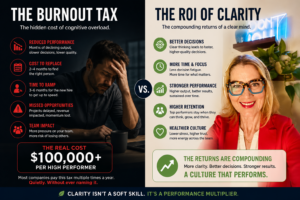
Here’s the dangerous part: high performers can function long after clarity has started declining.
A high performer looks successful from the outside. You still show up, execute, deliver just like everyone expects you to do.
Internally your thinking becomes reactive. You might feel your patience dwindling because you’re juggling so much at one time. Your decision quality drops because you’re struggling to get through the day and wind up dropping into bed mentally and physically exhausted. The worst part? The space to do your best strategic thinking gets smaller and smaller. Now you’re operating in response mode instead of intentionality.
I realized breathing really wasn’t the issue
I realized I had built a life and leadership style where there was never space to pause long enough to hear myself think.
And honestly, I didn’t want to build another system that required massive amounts of time or training to maintain. Time? What leader feels like they have extra time?
I was already doing many of the “right” things for work/life balance. Exercise, done! I’ve always been a runner so that wasn’t the problem. I paid attention to nutrition since my family has a history with diabetes and heart disease. Could I have gotten more sleep? Yeah probably.
I thought eating right and staying active would be enough to manage stress and maintain performance.
But even after a healthy lifestyle, something was still missing. What I didn’t realize at the time was that physical recovery alone wasn’t clearing the cognitive overload.
My body might have been moving, but my brain was still carrying unresolved pressure from one decision to the next. You know the feeling when you go to bed and your brain can’t shut off? Yeah – that’s the one.
What was missing were short cognitive resets. These small moments that would allow my brain to clear the mental noise before stepping into the next problem, next meeting, next decision, or next conversation that required my full attention.
I didn’t need hour-long routines. I needed ways to interrupt the overload in real time.
I realized that when people are overloaded, exhausted, and mentally stretched thin, they are not looking for another complicated process to manage. It just feels like more work or another task added to the already full plate.
What they needed, and let’s be honest, what I needed, was something to use in the middle of real life. So I stopped treating burnout like an energy problem and started treating it like a decision clarity problem.
The Shift that Changed Everything
The realization that I needed short, micro-resets became the foundation for what we now teach in our Clarity Under Pressure podcast.
Honestly, we built these because I needed them myself. I didn’t have the time, patience, or mental space for long meditation practices in the middle of executive leadership, nonstop meetings, constant decisions, and high-pressure environments.
I needed something short and practical where I could pause and reset between meetings, before a difficult conversation, after a stressful call, when I felt overwhelmed and my thoughts were spinning or in the middle of a high pressure moment.
These were never designed to be meditation for the sake of meditation or “self-care” disconnected from the reality of my day.
They were built as short cognitive resets to interrupt the noise long enough to think clearly again.
Because I’ve realized something important: Our brains were never designed to carry this level of constant cognitive load without a way to reset.
We weren’t built to carry endless notifications, nonstop decisions, back-to-back meetings or continuous pressure without recovery. At some point, the brain stops processing intentionally and starts protecting itself. When we default to the pressure to perform, we become reactive instead of intentional.
Sometimes the most powerful thing a leader can do isn’t pushing harder, it’s pausing long enough to notice: Am I actually choosing this? Or am I just reacting to momentum?
That tiny interruption matters more than most people realize.
One breath. One pause. One reset. That’s often where clarity begins returning.
If you’ve been operating under constant mental pressure, reacting more than reflecting, or feeling mentally overloaded before the day is even over, this is exactly why we created the 5-Day Clarity Challenge.
It’s five short days using simple cognitive resets and creating real-world awareness of where your clarity is breaking down and how to regain it.