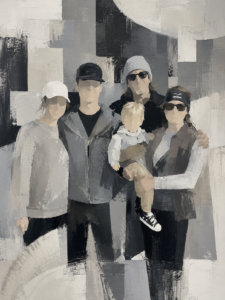
I spent years believing that my ability to stay calm in chaos was simply part of who I was. What I didn’t realize is what I learned as part of my family system shaped how I approached leadership under pressure.
I built a career leading teams, managing high-pressure situations, and making decisions when the stakes were high. I thrived in fast-moving environments. I became the person others relied on during difficult moments. I could remain calm while other people were freaking out. I gravitated towards roles like IT, breach response, operations, sales where I managed many crises.
For a long time, I saw the ability to remain calm within the storm as a strength. But, what I didn’t understand until much later was that many of those capabilities weren’t simply leadership skills. They were quietly defining how I handled leadership under pressure.
They were learned survival skills.
The first leadership team you ever belonged to was your family
Long before you had a manager, a title, or direct reports, you belonged to a family system.
Family systems theory suggests that each family develops patterns, roles, and unspoken rules that help the system survive. Children learn these rules early because, from a biological perspective, survival depends upon maintaining attachment and safety. Our nervous systems are shaped within these environments.
I grew up in a home that was unpredictable. When my parents were still together, there was conflict, fighting and late-night arguments. When my parents divorced when I was still very young, everything changed. My father moved overseas and was largely absent from our lives. My mother returned to work at age thirty-nine, and as the oldest child, I naturally stepped into a caregiving role for my younger siblings. It was hard, and we lived in poverty. Financial insecurity wasn’t an occasional concern. It was our daily reality.
Without realizing it, I developed a set of beliefs:
- Be responsible.
- Take care of everyone else.
- Don’t create additional problems.
- Work hard.
- Stay alert.
- Never waste an opportunity.
- Financial security equals safety.
Those beliefs became the operating system that shaped how I approached school, work, leadership, and achievement. When I led organizations, they shaped my leadership under pressure.
Why your brain reacts the way it does under stress
When pressure increases, the prefrontal cortex, the part of the brain responsible for planning, strategic thinking, and executive decision making, can become less effective or go offline completely. At the same time, the amygdala and other threat-detection systems become more active.
Your brain isn’t asking: “What is the most strategic decision?”
It’s asking: “What kept me safe before?”
Research in neuroscience shows that early experiences influence how our nervous systems interpret threat, uncertainty, and ambiguity throughout adulthood. In other words, how you react in your work environment may not be about the meeting happening today.
Because those early childhood experiences are replicating patterns today learned decades ago.
How family systems show up at work
Fight
Some people learned early that safety came through control. As adults, this can appear as:
- Taking over discussions.
- Becoming argumentative when challenged.
- Micromanaging.
- Pushing for immediate decisions.
- Defending ideas aggressively.
The nervous system interprets uncertainty as danger, and control becomes the strategy for regaining safety.
Flight
Others learned that safety came from achievement, over-functioning and planning for every possible negative outcome. This was my coping strategy. But flight for me wasn’t the act of retreating or running away. Sometimes it looked like:
- Working longer hours than everyone else.
- Over-preparing.
- Constant productivity or not wanting to appear lazy.
- Difficulty resting.
- Needing to prove value repeatedly.
- Perfectionism.
- Taking charge and managing everyone else.
Achievement becomes protection and success becomes safety.
For many high achievers, work isn’t just work. It feels reassuring and affirms that you have value and worth. That was my family system.
Freeze
If childhood environments felt unpredictable or overwhelming, the nervous system may respond by shutting down under pressure. At work, freeze can sound like:
- “I need more data.”
- “Let’s revisit this next week.”
- “I’m not ready to decide.”
- “What if we make the wrong choice?”
Decision paralysis often isn’t a lack of intelligence. It’s a nervous system attempting to avoid perceived danger.
Fawn
Psychologists increasingly recognize a fourth response: fawn. Children growing up in conflict often learn to maintain peace by managing everyone else’s emotions. In organizations, this may appear as:
- Avoiding difficult conversations.
- Struggling to give direct feedback.
- Saying yes when you mean no.
- Seeking consensus at all costs.
- Prioritizing harmony over truth.
You can’t lead effectively if your nervous system believes disagreement threatens belonging.
The hidden cost of survival strategies
Survival strategies and behaviors that helped us survive childhood can become behaviors that limit our leadership especially in times of extreme pressure.
Hyper-responsible children become hyper responsible adults and executives who struggles to delegate.
Peacemakers struggle to create accountability.
An overachiever takes on more and more work until they burn out.
The director micromanages.
The protector shields the team from negativity, crisis or finds themselves micromanaging.
Independent kids don’t know how to ask for or outright refuse support.
Because, what once protected us can eventually start to constrain our performance.
Clarity under pressure begins with awareness
We can’t eliminate our initial reactive responses, but what we can do is to recognize what is happening before those thoughts or emotions make decisions for us.
When you feel pressure rising, pause and ask: What am I reacting to right now?
Then ask: Is this situation actually dangerous, or is it simply a story I’m creating?
That single question can create enough space for the prefrontal cortex to re-engage. In Awakening Performance, we use the G.E.A.R. reset to interrupt automatic reactions. Part of the process is to actually write down and reflect on what is happening in the moment.
Ground
Calm the nervous system first. Slow breathing, movement, or a brief pause can reduce physiological arousal and widen cognitive capacity.
Explore
Separate facts from assumptions.
- What do I know?
- What story am I telling myself?
- What evidence supports that story?
Attune
Notice what old patterns may be activated.
- Am I trying to control?
- Am I over-functioning?
- Am I avoiding?
- Am I protecting?
Resolve
Identify one next step. Clarity rarely arrives all at once. It emerges one thoughtful decision at a time.
Your past explains you. It doesn’t define you.
I’m not embarrassed about where I came from to who I am now. And I don’t regret having great responsibility placed on me at an early age. My experience helped shape my resilience, empathy, grit, and leadership. But what I know now is that surviving and leading aren’t the same thing.
Leadership requires you to pause and become aware of when your childhood operating system has taken over and then intentionally choose a better response. High-performing leaders experience stress but they learn how to regulate their nervous system to distinguish between past survival patterns and present reality.
By reducing reactivity and urgency, they can make better decisions and maintain clarity under pressure.
Reflection Question
When pressure rises at work, what family role are you unconsciously stepping back into?
- The director?
- The caregiver?
- The peacemaker?
- The achiever?
- The protector?
Awareness may be the first step toward reclaiming your clarity. If you’re about to react, use the 60-Second Reset before you say or do something you regret.
Clarity under pressure begins when you stop asking, “What’s wrong with me?” and start asking, “What taught me to respond this way?”